Music history, genres and styles
Relate musical language to historical and cultural contexts.
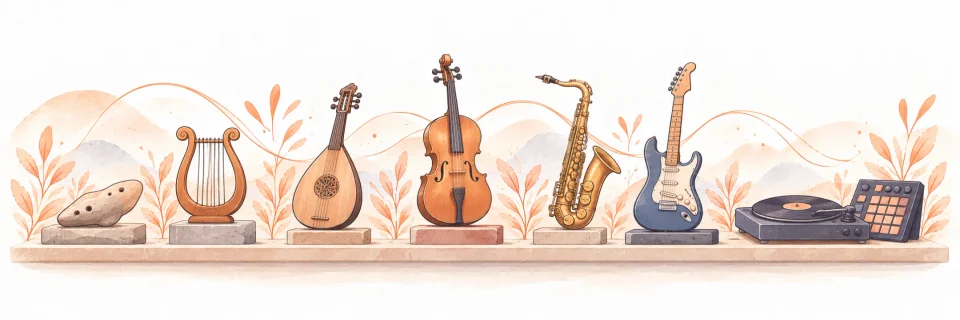
- Entry point
- Interest in listening; detailed analysis uses form, texture and harmony support.
- Path goal
- Interpret a new work with musical evidence and identify the limits of generalizations.
The level describes the knowledge needed to start. Times cover the core lessons, including listening and practice; optional work is listed separately.
Path stages
Context and sources
Instrument families, timbre, and range
Compare sound production, timbre, range, and musical roles; use a new instrument source to distinguish playable notes from a performer's comfortable range.
- Texture and musical layers
Compare layer roles and transform a new melody from one line into a contrasting texture.
About 10–35 min
- Place music in historical context
Support a contextual interpretation with musical evidence and a relevant source.
About 15–45 min
Early periods
Baroque and Classical
- Baroque and Classical music
Compare two works using musical evidence and a source about their historical setting.
About 20–65 min
- Galant schemata and historical models
Identify recurring upper-voice and bass patterns, transpose their core relationship, and use a schema in a short phrase.
About 15–50 min
Sonata and Concerto Form
Identify exposition, development, recapitulation, and returning orchestral passages from musical evidence.
From Romanticism to today
- Romantic music to the present
Interpret an unfamiliar work with musical and historical evidence without presenting styles as a single timeline.
About 20–60 min
- Pitch Languages of the 20th and 21st Centuries
Analyze a new excerpt through pitch collection, centers and layer movement; support a reading and consider an alternative.
About 10–35 min
Song Form, Hooks, and Lyrics
Relate song sections, hooks, and word stress to their musical roles.
- Blues and Jazz Forms
Track chorus and section boundaries, then create a phrase-positioned variation without moving harmonic landmarks.
About 10–40 min
Comparative listening
- Whole-Work Analysis
Support an interpretation with observations from several musical dimensions and state its limits.
About 15–50 min
Timbre, texture, and form
Identify timbre, layer changes, and thematic returns in separate time-window responses to new audio.